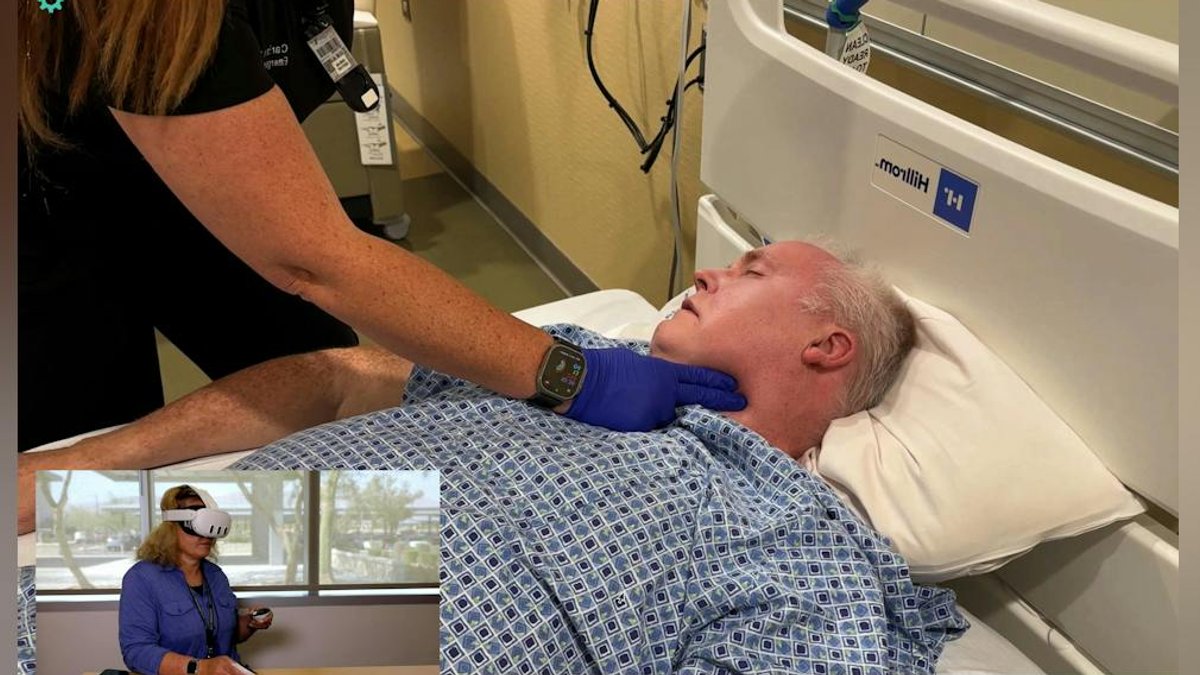
When Bonnie Barti looked at staff education at the Southern Nevada Department of Veterans Affairs, she saw a gap that technology might be able to help solve. The VA had a long history of using virtual reality in direct patient care, but staff education was another story. There was no computer-based or VR-enabled staff education at the site, leaving training constrained by classroom availability, scheduling and the need to pull employees away from their regular duties.
AI Virtual Humans And 360-Degree Video Scenarios
For Barti, a simulation technician, the question became whether immersive technology could bring a more realistic training experience to staff without requiring them to leave the floor. That work has earned Barti one of Healthcare Innovation’s annual Innovator Awards, which recognizes innovative approaches to improving healthcare. The system she helped develop offers two primary approaches. The first uses AI-enabled virtual humans that staff can interact with through a computer. The scenarios are largely focused on communication and other “soft skills,” allowing employees to practice conversations that can be difficult to replicate consistently in a classroom.
Those scenarios range from interacting with disruptive patients and addressing suicidal ideation to substance abuse counseling, delivering a death notification, disclosing an adverse event to a family member and providing feedback to an employee. The second component uses 360-degree video recordings of actual VA workspaces. Those environments can be accessed through a computer or through an immersive VR experience. The scenarios include the first five minutes of a code, a START mass-casualty incident, suicidal ideation in a clinic, donning and doffing personal protective equipment and introducing a new staff member to the Emergency Department.
Getting from the idea to an operational program required considerably more than finding an interesting VR demonstration. Barti spent several years watching available platforms evolve before selecting one that she believed met the program’s needs. She wanted a platform that could support both virtual humans and 360-degree scenarios, while also giving the team the ability to create its own content. The platform’s no-code authoring capabilities were particularly important.
Read Also: Team Wins Innovator Award for Rural Surgery
“Since the program is no-code, it is very easy to create training by following the pattern of information needed for the AI virtual human to be exactly what we need for any verbal training scenario,” Barti said. Quentin Hart, simulation coordinator for the simulation center and someone who has worked with Barti for seven years, said her approach to selecting the technology was deliberate. “She did not simply go after the system with the best marketing or shiniest demonstration,” Hart said. Instead, Barti evaluated multiple systems and vendors based on what the program actually needed, including off-hours access, standardized simulation scenarios and the ability to generate quantifiable results.
The Technology And Contracting Process
But even after selecting the technology, there was another hurdle. “The biggest challenge by far was the contracting process,” Hart said. Barti had to handle what Hart described as a complicated process filled with regulations and barriers that could have derailed the project. Once the system was in place, Barti worked with subject-matter experts to develop the initial content. That combination of technology evaluation, persistence and collaboration is a major part of what Hart sees as innovative about her work.
Making Simulation Available Anytime One of the most significant differences from conventional simulation is accessibility. Learners can access the scenarios when their schedules allow, rather than waiting for a particular classroom session or simulation event. They can also repeat scenarios, giving them an opportunity to improve their performance and learn from feedback.
Hart said learners were impressed by the ease of accessing the simulations and by the ability to repeat them. “For many, this was their first experience with VR instruction/simulation,” he said. That repeatability is important. Traditional simulation can provide a valuable but relatively limited window for practice. An on-demand digital environment creates the possibility of returning to a difficult scenario multiple times. The program also allows the VA to measure performance.
Read Also: Virtual CKD Solutions Ineffective, Peterson Report Finds
Early Results Show Learning Gains And Positive Feedback
Early results suggest the approach is producing measurable learning gains while significantly reducing the cost associated with traditional training. During the first pilot year, approximately 250 staff members participated in the platform, according to Barti. Participants showed an average 12.7% increase in performance knowledge in the current offerings. Individual courses produced knowledge gains ranging from 7.2% to 32.5%. The program also tracks confidence through pre- and post-assessments tied to the objectives of each scenario.
Staff feedback has been “overwhelmingly positive,” Barti said, with participants describing the training as realistic, accessible and engaging. One participant compared the virtual patients favorably with systems they had encountered during graduate school, telling Barti that the AI experience was “much better” and that it responded more naturally. For Barti, that kind of response speaks to an important part of immersive learning: realism. The objective isn’t to replace the human element of healthcare education. Rather, it is to create additional opportunities for staff to practice difficult interactions in an environment where they can make mistakes, receive feedback and try again.
The ability to create and modify scenarios also allows the organization to work with subject-matter experts to build training around specific clinical and workplace needs. Barti’s vision extends beyond the initial training offerings. The team is exploring ways to expand its library of scenarios, increase interactivity and adapt modules for additional clinical roles. It is also increasing the number of licenses and preparing to train additional content creators. Hart sees an even broader opportunity.
Future Plans For Expanding The Simulation Library
Hart envisions a future in which simulation becomes a shared resource rather than something every facility has to build independently. “She envisions a ‘library’ of simulations that could be accessed by a number of facilities,” he continued. But scaling that vision will require more than technology. Hart said a coordinated national approach, potentially involving SimLEARN, will be necessary to expand the model across VA facilities.